

The ROAS Math: What Fraud and Hidden Fees Are Really Costing You
Over the past two weeks, we've covered how fast CTV fraud is growing and the KPI most advertisers still aren't tracking. This week is about money: what fraud and excess fees stacked on top of it, are actually doing to your return on ad spend.
The first two posts in this series covered the fraud itself and the measurement gap that lets it hide. This one is about money: what invalid traffic costs on its own, what gets layered on top of it in fees, and what the two together are doing to your ROAS.
What invalid traffic actually costs
Every bot impression, every spoofed app, every fake viewer still shows up as a line item on your invoice. It just doesn't show up as a real person seeing your ad.
It gets more specific than that. DoubleVerify's 2026 Global Insights Report found that only 66 of every 100 CTV ads it monitored actually ran inside real streaming TV content. The rest served on look-alike apps, fitness apps, screensavers, and other environments that can technically run on a CTV device but aren't the premium inventory advertisers paid for. DoubleVerify puts the cost of that misplaced spend at roughly $4 billion a year, and most advertisers don't even know it's happening.
Filtered correctly, that gap closes fast. Fraud-Free CTV's own benchmarks show up to a 30% lift in working media once invalid traffic gets filtered out of a campaign, meaning close to a third of what advertisers were paying for wasn't reaching a real viewer in the first place.
That's before a single dollar goes toward fees, ad-tech markups, or commissions. It's just what fraud alone takes off the top.
Curious how much of your own spend is going to bot traffic right now? Ask us for a free exposure check.
The fee layers nobody talks about
Fraud isn't the only thing standing between your budget and a real viewer. The ANA's Programmatic Media Supply Chain Transparency Study found that industry-wide, only 36 cents of every dollar spent in the open programmatic market actually reaches the consumer. Roughly 29 cents goes to transaction costs and ad-tech intermediary fees. Another 35 cents goes to low-quality media, including invalid traffic and non-viewable inventory.
Put a real number on that gap and it's easier to feel. DoubleVerify estimates that skipping media quality protections costs advertisers about $2.25 million for every billion impressions bought, and skipping fraud protection specifically accounts for $1.8 million of that. That's not a rounding error. That's the kind of number that shows up in a quarterly budget review.
Stack a typical commission structure on top of that, and the math gets worse before it gets better. CTV Media doesn't add layers of high commissions and administration fees on top of your media spend. Fewer layers between your budget and real inventory means fewer places for cost, and fraud, to hide.
Want to see where your current spend is actually going? Let's map it out together.
What that adds up to on the other side
This isn't hypothetical. DoubleVerify's fraud lab found bot traffic eating into supposedly safe, direct-deal CTV inventory at some of the largest brands in the world: 34% of one consumer healthcare campaign, 25% of a fast-moving consumer goods campaign, and 14% of a pharmaceutical campaign, all served to bots, all still billed at premium rates.
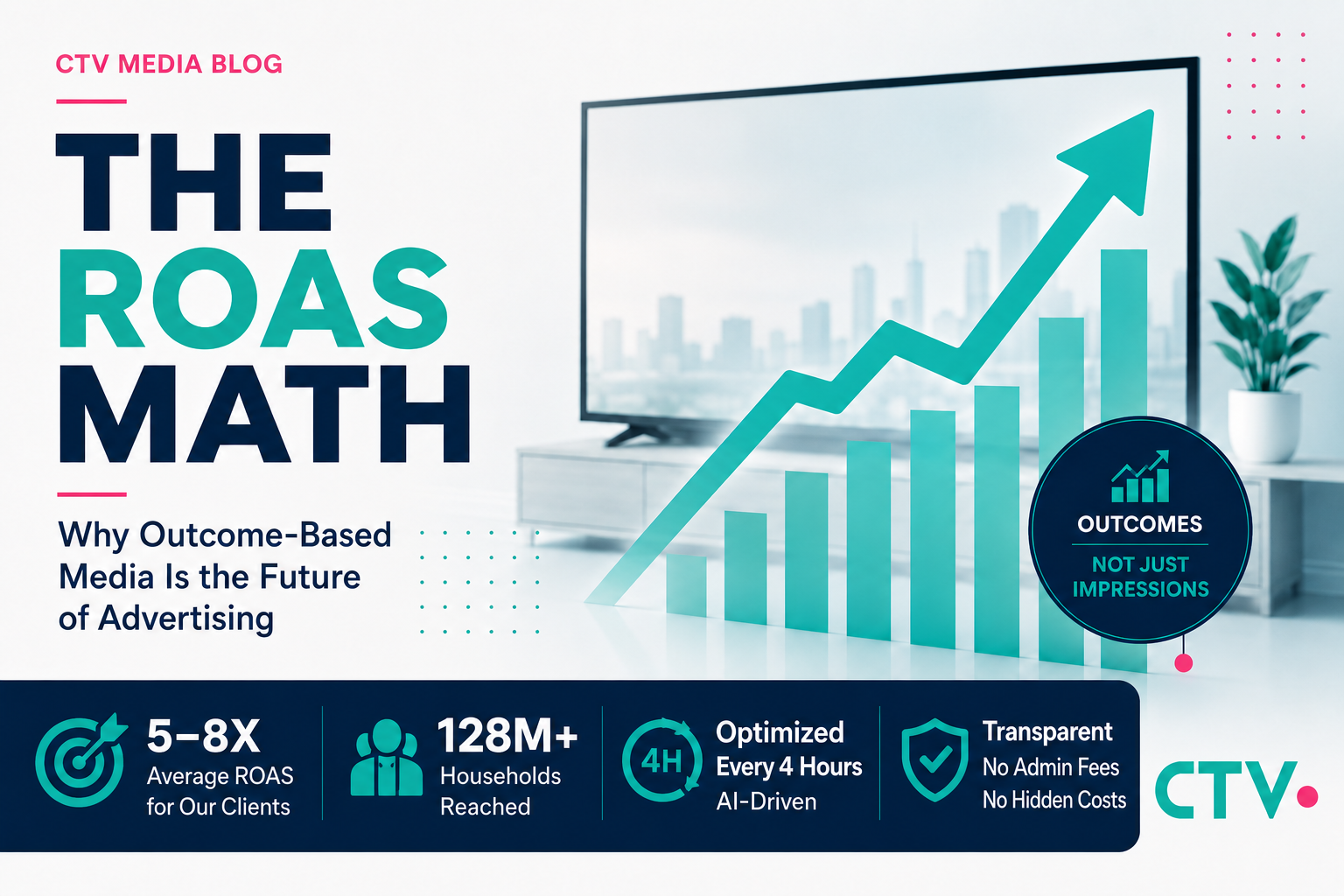
Take fraud out of the equation and strip out unnecessary fee layers, then your return on ad spend tells a different story. Across CTV Media's case studies, clients have seen an average of 4.8x ROAS, a result of media verified as real and a fee structure that doesn't quietly tax the difference. More advertisers are catching on to this measure too: ROAS already ranks among the top metrics marketers use to judge CTV performance, alongside cost efficiency and reach.
We're happy to run a live test on your own campaigns to show what that lift looks like against whatever source you're using today.
See how past campaigns have performed in our case studies, or reach out to set up a test.
The bottom line
Fraud and hidden fees are two different problems, but they cost you the same way: less of your budget reaching a real viewer. Fraud-Free CTV closes the first gap with pre-bid filtering and continuous verification. A flat, transparent fee structure closes the second.
Together, that's what turns into an average 4.8x ROAS for CTV Media clients, and it's why we're comfortable proving it with a live test instead of asking you to take our word for it.
Two Posts, Two Pieces of the Same Problem
This series started with where fraud actually hides, then covered the KPI most advertisers still aren't tracking. This post ties both to the number that matters most: your ROAS.
The Cost of Doing Nothing The KPI Blind SpotReady to see what your own ROAS number could look like?
Let's run a live test on your current campaigns and show you exactly what fraud and fee layers are costing you today.
Talk to CTV MediaPrefer the data first? Request a free audit of your current CTV inventory.
- DoubleVerify, 2026 Global Insights Report: Must-CTV, Streaming's Shift From Promise to Performance (May 2026)
- Pixalate, Q1 2026 Malformed & Fraudulent CTV Bundle IDs Risk Report (May 2026)
- ANA (with TAG TrustNet), Programmatic Media Supply Chain Transparency Study
- CTV Media, Fraud-Free CTV